This is the online portal for West Virginia's Transportation Alternatives and Recreational Trails grant programs administered by WVDOH. The FAQ have been updated; users are advised to read the FAQ prior to submissions.
IMPORTANT! For FFY 2026, all projects/phases will be 100% Federally Funded.
Frequently Asked Questions
On November 15, 2021, the Infrastructure Investment and Jobs Act (IIJA), Public Law 117-58, also known as the "Bipartisan Infrastructure Law" (BIL), was signed into law. The Transportation Alternatives funding is a set-aside of Surface Transportation Block Grant (STBG) program funding and includes all projects and activities that were previously eligible under TA. It is a reimbursable program for nontraditional transportation projects and includes funding for competitively selected projects including design and construction of on road and off road trail facilities for pedestrians, bicyclists and users of other nonmotorized forms of transportation.
These projects include sidewalk construction, bicycle infrastructure, pedestrian and bicycle signals, traffic calming techniques, lighting and other safety related infrastructure, conversion of abandoned railroad corridors for trails for pedestrians, bicyclists or other nonmotorized transportation users, construction of turnouts, overlooks and viewing areas, inventory, control or removal of outdoor advertising, historic preservation and rehabilitation of historic transportation facilities and environmental mitigation activities.
Although it is a federal grant program, administration of the program is delegated to the West Virginia Division of Highways (WVDOH). The funding for the TA grants are 80% federally funded and require a 20% non-federal sponsor cash match (cash up-front). Please follow the link below to the Federal Highway Administration's Transportation Alternatives (TA) Guidance for a complete breakdown of the program:
TA Guidance:
https://www.fhwa.dot.gov/environment/transportation_alternatives/guidance/
The RTP is a set-aside of the TA funds to provide and maintain recreational trails for both motorized and non-motorized trails. This program is also administered by the WVDOH. The RTP, through a competitive process, provides project funding for pedestrian, bicycle, and equestrian facilities, in-line skating, cross country skiing and off-road motorized vehicles. The RTP grants are also 80% federally funded and require a 20% non-federal sponsor cash match. Please follow the link below to the Federal Highway Administration's Recreational Trails Program (RTP) Guidance for a complete breakdown of the program.
RTP Guidance:
https://www.fhwa.dot.gov/environment/transportation_alternatives/guidance/
Under the TA, eligible applicants are as follows:
- Local governments
- Regional transportation authorities
- Transit agencies
- Natural resource or public land agencies which may include Federal, State, or local public land agencies
- School districts, local education agencies, or schools
- Tribal governments
- New: Metropolitan Planning Organization for small urbanized area (under 200,000)
- Nonprofit entity (New: restrictions removed)
Under the RTP, organizations must be government bodies or non-profits in good standing with the Secretary of State's office.
Yes, there are several options an applicant has to apply for a grant, as follows:
- If a potential project is in the infant stages and has not matured to a definitive project scope and initial planning, including cost estimates, and feasibility cannot be accurately defined, the applicant may apply for a design-phase award only. Then, once the design is complete, the applicant may apply in a subsequent cycle for the construction funds. Please note, if an application is received for both design and construction, reviewed by the WVDOH, and if the WVDOH determines that design should be completed prior to awarding funding for construction, it is at the discretion of the WVDOH to recommend a partial award to include the design phase only.
- If the applicant completes the project design prior to applying for funding, the applicant may apply for construction funding only. If this option is chosen, designs must be created using WVDOH standards, and the completed plans will need to be submitted along with the project application for verification they are complete and the project is eligible for funding.
- Please note: Previously-awarded design projects - Sponsor may apply for construction phase regardless of the status of the design.
All projects with a design phase funded using Transportation Alternatives (TA) or Recreational Trails Program (RTP) funding, including those with a design only award, must agree, through the project agreement, that the plans, specifications, and estimate package will be utilized in the construction of a completed project within ten (10) years of the design funding authorization. 23 CFR 630.112(c)(2) requires repayment of all federal funds used in the design and development of a project where construction has not been initiated within ten (10) years of authorization of engineering funds. This does not mean that TA nor RTP are required to fund the construction as it may be funded by any means (other grants, local funds, donations, etc.), but must be at least under construction within ten (10) years of federal authorization of the design funding.
- The TA funds are distributed throughout the State as outlined in
the following diagram:
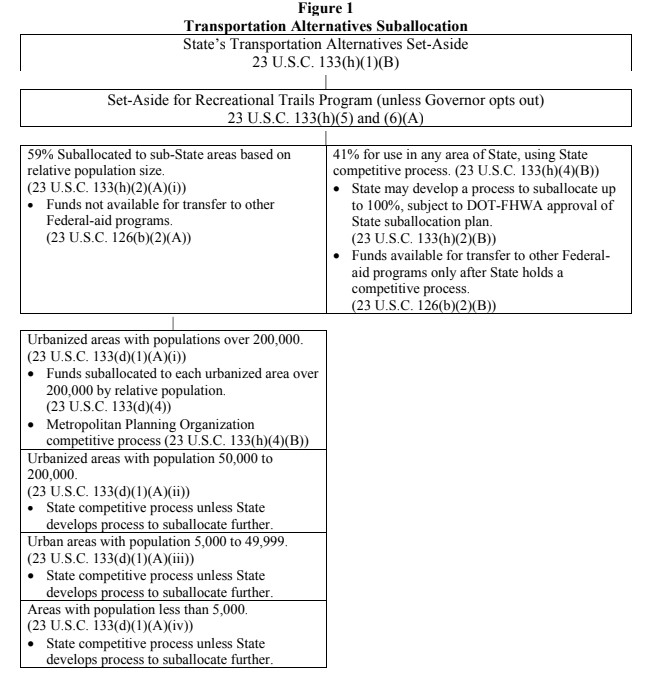
- In regard to the "To Urbanized Areas with Populations over 200,000"
referenced above, West Virginia has one region fitting this criterion comprised
of two urbanized areas: Huntington and Charleston. These two areas combine to
form a Transportation Management Area (TMA), and the TA funding is managed by
the local metropolitan planning organizations (MPO). The Huntington area is
managed by the KYOVA Interstate Planning Commission (KYOVA) and the Charleston
area is managed by the Regional Intergovernmental Council (RIC). Each area
receives limited funding each year specifically for the TA.
KYOVA Link: http://www.kyovaipc.org
RIC utilizes the standard WVDOH online application process and will prioritize those applications for their limited funding. Projects within the Charleston area are selected following the competitive process for this area.
RIC Link: http://www.wvregion3.org - Potential project sponsors outside the RIC or KYOVA areas should apply through the WVDOH application process. Potential sponsors located within the RIC or KYOVA areas may also apply for funding through the WVDOH application process. Please note that potential sponsors within each of the urbanized areas should consult RIC or KYOVA, as appropriate, to ensure an understanding of their management of their limited TA funding. Applications submitted for funding within the RIC TMA area will be prioritized first by the RIC with available TMA funds. Any remaining unfunded projects will then be considered for WVDOH Statewide TA funding.
- Based on how the required 20% non-federal match is met and who is advertising,
letting, and awarding the project (either the WVDOH or the grant recipient),
there are multiple funding alternatives available to grant recipients, as
follows:
- If the grant recipient pays the full 20% non-federal match by check prior to the project being federally authorized, the recipient may send unpaid invoices for 100% payment to the WVDOH. The grant recipient may then pay the invoices following receipt of payment from the WVDOH.
- If the grant recipient does not pay the required 20% sponsor match up front, the recipient must pay invoices received by the grant recipient. The grant recipient may then submit respective invoices and proof of payment for REIMBURSEMENT of 80% of eligible charges. This is referred to the "Pay as you Go" method and allows the recipient to pay the required 20% match over the life of the project. (EXAMPLE: Recipient submits an invoice with all required documentation for $100.00. The WVDOH would reimburse $80.00 of the invoice allowing the 20% match to be met at the time each invoice is paid).
- The Sponsor must receive a written Notice to Proceed prior to spending any federal funds for which they seek reimbursement.
100% Federal Funding is available for FFY 2026.
This will vary on a project-by-project basis based on the complexity of each project. Various factors may lengthen one or more of the necessary steps in the development of a project including, but not limited to: the need for geotechnical evaluation; the project involves a historic structure, or the project area of effect is within or adjacent to a National Register of Historic Places (NRHP) site, historic district, or potential historic district deemed eligible for inclusion in the NRHP but not yet included; endangered species are located within or near the project area, drainage, right of way, utility and other ancillary aspects of project development, etc.
The aforementioned factors are the exception, not the rule; generally, the project's sponsor should expect 1 to 1-1/2 years before all required project components can be in place for construction to begin. Then, once all the required components are in place for the project to be advertised, let, and awarded to a contractor, and depending on the type of project involved, weather may also delay moving forward into the construction phase. For most pedestrian/bicycle infrastructure projects (sidewalks, bicycle lanes, striping, etc.) the construction season runs from mid-March to late October or early November.
- The project sponsor may advertise for a consultant following the West Virginia State Code Chapter 5G "Procurement of architect-engineer services by state and its subdivisions." This process is known as the Consultant Selection Process and is a federal requirement when selecting a consultant based on competence and qualification. Furthermore, if this option is chosen by the grant recipient, the recipient, prior to advertising, must submit and have the process used for selection certified by the WVDOH Grant Administration Unit. For more information regarding the Consultant Selection Process, please follow this link: http://www.legis.state.wv.us/WVCODE/Code.cfm?chap=05g&art=1
- Some cities and counties have an Engineer of Record and may use that consulting firm or individual to perform project design services. If this option is chosen, the project sponsor must show supporting documentation outlining that the Consultant Selection Process was followed in the selection of the consultant. Furthermore, the contract between the consultant and the sponsor must specifically outline the type of work to be designed under the grant.
- If the sponsor has an engineering staff, the sponsor may elect to have its own staff design the project.
- The WVDOH offers the use of its On-Call Consultant option. This option allows a sponsor to utilize a consultant previously selected by the WVDOH through its Consultant Selection Process. Please note that the use of a particular firm from the WVDOH's approved consultant list may not be guaranteed, since the WVDOH distributes the project work assignments.
- To summarize, under this program, consultants previously selected by the WVDOH through the required consultant procurement process may be used to design awarded grant projects. These consultants work directly for the WVDOH. However, in partnership with the WVDOH, the grant recipient's envisioned scope of work and continued input during design development will play a vital role in the development of the project plans.
- The design phase of the project will be 80% federally funded and require a 20% local sponsor match. This allows for the design phase of the project to start earlier in project development, since the consultant procurement process has previously been performed. Use of a WVDOH on-call consultant requires a project fee agreement between the WVDOH and the selected consultant. Once a fee is negotiated and an agreement is executed between the WVDOH and the selected consultant, the grant recipient must provide the 20% non-federal share of the design consultant cost at the time the agreement is signed.
- Any project utilizing WVDOH On-Call design services is expected to be advertised, let and awarded by the WVDOH. The WVDOH will follow all federal and State laws and guidance regarding the advertising, letting and awarding requirements as developed by the on-call consultant. The on-call consultant, as well as WVDOH staff, will provide construction administration and inspection services during construction. The fees for this necessary service will be funded by the grant and will reduce the amount available for physical construction.
There are several steps in the competitive process of selecting which projects will be awarded funding from both the TA and the RTP. The steps for each are as follows:
- All Sponsors must submit an online Intent-to-Apply (ITA) form prior to the deadline on the WVDOH Grant Application website. Immediately following the ITA deadline, if not before, each ITA is determined eligible or ineligible by the TA Manager or the RTP Manager. Only those Sponsors whose ITAs are deemed eligible by the TA Manager or the RTP Manager may access the website to submit an application. No ITAs will be accepted in paper or in any other format than the website.
- The Sponsors must then complete their applications online and provide all necessary documentation prior to the deadline. No applications will be accepted in paper or any other format than via the website.
- Immediately following the application deadline, each application is screened again and determined eligible or ineligible by the TA Manager and the RTP Manager. Only applications or portions of applications deemed eligible will be considered for funding.
- Eligible applications will be evaluated and project locations investigated, videotaped and/or photographed by WVDOH Grant Administration Unit Staff to ensure the accuracy of information submitted in the grant application, as well as any potential problems or omissions that may affect the feasibility of the proposed project.
- The TA grant applications are reviewed as outlined above, and then a Committee with backgrounds in grant administration, environmental evaluation, landscape architecture, engineering, etc., is tasked with evaluating and ranking each application. The projects are ranked from highest to lowest and may include a recommendation to fund only a particular phase, or to partially fund the overall project. The projects that rank highest will be recommended for a grant award based on available program funds and considering geographic equity and categorical distribution based on the eligible categories. Projects not ranking high enough prior to the exhaustion of the available TA funds will not be recommended for a grant award.
- RTP projects are selected by the West Virginia Recreational Trails Advisory Board (WVRTAB). As outlined in law, the WVRTAB reviews and scores all RTP applications during an annual WVRTAB meeting.
There is no set award schedule. Once awards are finalized, we will notify each sponsor.
Potential applicants must be registered online and form or join a sponsor group to begin the grant application process. There are detailed instructions regarding registration, and a help number will be made available should you need personalized assistance. Applications are received annually through a formal online web application process that involves two stages: "Intent-To-Apply" and subsequent "Application."
For the RTP there is a maximum of $300,000 (federal-aid portion) per application. While there is NO maximum for the TA, there are practical limitations due to the available funding and the number of competitive applications typically received in a year.
No, All proposals must be screened and considered eligible through the "Intent-To-Apply" process before the Application process may begin.
- The project application will be reviewed for completeness and accuracy by the Committee and, depending on funding availability and the competitive applications received, a recommendation will be made to either fully fund the phase(s) requested, partially fund the phase(s) requested, or recommend only a single phase (such as design) be funded for the particular year.
- Should the project phase(s) be only partially funded, or only a single phase (such as design) be funded, the grant recipient would be eligible to apply to complete the project during a subsequent application cycle.
Generally, yes. The single exception to this is when the project involves the purchase of property. Should the necessary easements or right-of-way ownership not be secured at the close of the application phase, the application may be determined less competitive and thus, not rank as high.
Under the TA, the sponsor match can be (1) Up Front, (2) "Pay-as-you go", or (3) Property Donation.
Under the RTP, the sponsor match can be (1) Up Front, (2) Pay as you Go", (3) Property Donation or (4) "In-Kind".
- Up Front: The sponsor pays the required 20% non-federal sponsor match by check at the time the project agreement between the WVDOH and sponsor is executed.
- Pay as you Go: The Sponsor will pay all invoices associated with the project and then will submit copies and proof of payment of those paid invoices to the WVDOH for reimbursement of up to 80% of the total amount.
- Property Donation: If property, such as land or a structure, is donated or purchased using funds not included in the grant, the Fair Market Value (FMV) of the property may be used as all or a portion of the required non-federal share (match). Requires a certified appraisal.
- In-Kind: Only the RTP allows for the use of in-kind payment of the non-federal required share (match). In-Kind is defined as donations of materials, equipment and/or volunteer services or labor.
Yes. Title 23, USC requires that a specific set of plans, specifications, and estimates (PS&E) be developed for the project.
Yes. Long-term maintenance requirements will be established as part of the project agreement process with the grant recipient.
Yes, but each sponsor must seek and receive written permission/authorization for each project before "Force Account" work can be used.
Monthly or bi-monthly, depending on the progress of the work.
No. An abbreviated package of suitable design documents for FHWA authorization of the funding and for use in the environmental clearance of the project is needed.
Yes. In fact, your project will require a full set of plans, specifications, and estimates (PS&E) in accordance with Title 23.
Yes. The design and construction of the project must adhere to the Secretary of the Interior's Standards for Rehabilitation.
Yes. The grant recipient should consider any weather-dependent work during the winter season, generally considered to be between October 15th and March 15th in West Virginia.
Yes. This PDF document contains ordered screenshots in a printable format.
Travis W. Hayes, Transportation Division Manager II, Planning Division, by phone at (304) 414-6916 or by email at: Travis.W.Hayes@wv.gov
Jennifer M. Ballard, Senior Project Manager, Planning Division, by phone at (304) 414-6832 or by email at: Jennifer.M.Ballard@wv.gov